NewsProgramsGalleryTimelineAbout
Aids Prevention Initiative Nigeria

APIN Newsletters

PDF Format

Fall 2005

The Plus in PMTCT Plus

Mission Possible

Ethics in the Delivery Room

When is Breast Best?

Spring 2005

Update on APIN Plus

Safeguarding the Future

Harvard Initiative to Fund Research

Epidemic Trends in Jos

Winter 2005

Widening the Safety Net

Learning to Live Positively

Best Practices Across Borders

Lessons from Botswana

Celebrating a New Laboratory in Ibadan

Fall 2004

Raising Hope & Awareness

Access for All

Exploring Models of Care

A Call to Rewrite Rules

Scaling Up with APIN Plus

Summer 2004

APIN Plus Launched

A Nation Responds

Celebrating a New Laboratory

Preventing Mother-to-Child Transmission

Winter 2004

National AIDS Conference

Vulnerability of Women to HIV

Celebrating a New Laboratory

Challenges of Managing HIV Disease

Fall 2003

On the Waterfront

Building Capacity

Continent Bands Together Against HIV

World STI/AIDS Conference

Summer 2003

APIN Expands into New State

The Learning Curve

AIDS Leader Mourned

Measure for Measure

Bringing Hope to Sex Workers

Spring 2003

Winter 2003

Summer 2002

Spring 2002

Winter 2002

Fall 2001

Summer 2001

Spring 2001

  Latest News

Safeguarding the Future

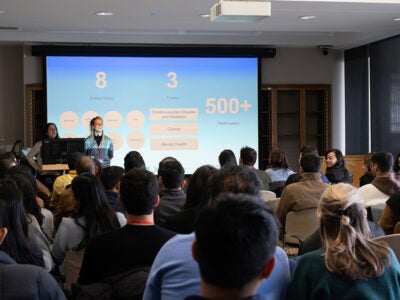
May–June 2005 – Nigeria has the world's highest number of AIDS orphans, and already at least 270,000 Nigerian children are infected with HIV. APIN Plus, the Nigerian component of the Harvard PEPFAR program, hosted a conference in Abuja to explore strategies for both preventing mother-to-child transmission of HIV (PMTCT) and providing treatment to children living with the virus.

Click here for a full report.


Best Practices Across Borders

January–February 2005 – In opening a recent AIDS conference, Dr. Patson Mazonde, director of health services in Botswana, offered a cautionary tale. There once was man, he said, who owned an orange grove. Determined to cultivate the nation's preeminent orchard, he trained his staff to become the best pickers, the best basket handlers, the best truck drivers. But at the end of an intensive day of training, not a single ripe orange had been plucked from any branch, and the baskets sat empty. "With the HIV epidemic spreading so quickly," Dr. Mazonde urged conference participants, "let's not neglect to take immediate, targeted action."

Click here for a full report.


Q & A with Dr. Lucas and Dr. Nasidi

Advisory Council members Dr. Adetokunbo Lucas and Dr. Abdulsalami Nasidi reflect on APIN's progress thus far.

Click here for a full report.


Dr. Chinedu Chugbo, APIN Fellow, Reflects on His Experience

"I had worked in a rural medical center in northern Nigeria, run a polio vaccination campaign, and served as a health program manager with an international nonprofit organization. But I wanted to take my public health career to a new level. My dreams became real when I learned that I had been awarded a two-year fellowship with APIN to pursue a master's degree in international health at the Harvard School of Public Health."

Click here for a full report.


APIN Delegates Shine at International AIDS Conference

July 2004 – Over 17,000 delegates descended upon Bangkok, Thailand, in July for the XV International AIDS Conference, one of the largest AIDS forums ever held. Each year, the conference aims to link community and science in order to galvanize the world's response to HIV/AIDS through increased commitment, leadership, and accountability.

APIN was represented at the conference by 20 delegates from Nigeria and the United States. "It's important for people from all around the world to share notes," says Seyed Jalal Hosseini, associate director of educational programs for APIN. "At the conference, we were able to tell the world what APIN has been doing for Africa, and how we've alleviated some of the pain and suffering."

Click here for a full report.


A Nation Responds

May 2004 – The bad news carried good news as well: an estimated 5,000 people showed up for the 4th National Conference on HIV/AIDS in Nigeria—3,000 more than had been expected. Although their attendance created a logistical nightmare, their swelled numbers also revealed the seriousness with which the country is responding to the epidemic.

Click here for a full report.


Celebrating a New Laboratory

March 2004 – Until recently, the West African International Collaboration for Scientific Culture World Laboratory had been the only laboratory providing HIV confirmatory tests in the country's north-central region. With infection rates skyrocketing, though, the need to improve the laboratory's capabilities had grown critical. So APIN teamed up with the Institute of Human Virology (IHV) at the University of Maryland and the Plateau State Government to establish the new center, based at Plateau State Specialist Hospital.

Click here for a full report.


APIN Plus UCH Lab Commissioning in Ibadan

February 2004 – The drums had been rolled out and the turnout was unprecedented, for the academic community had cause to jubilate. The commissioning ceremony in February celebrated not only the new APIN-supported HIV Reference Laboratory at University College Hospital (UCH) in Ibadan, but also recent advances against HIV.

Click here for a full report.


National Training Programs on Antiretroviral Drugs and Laboratory Monitoring Test for HIV/AIDS in Nigeria

January 2004 – The Nigerian Institute of Medical Research (NIMR), in collaboration with the National Action Committee on AIDS (NACA) and the Federal Ministry of Health (NASCP) and with support from APIN, will by the last week of January 2004 commence a nationwide training on clinical management of HIV/AIDS.

Click here for a full report.


Click here for older news items.

 
For More Information: AIDS Prevention Initiative in Nigeria
Harvard School of Public Health, 651 Huntington Avenue, Boston MA 02115 USA
Tel: +617-432-3297 Fax: +617-432-3298 Email:
apin@hsph.harvard.edu